

One diploma, three models.
Let us begin with what separates nobody. In France, anyone teaching skiing for payment holds the Diplôme d'État de moniteur de ski, awarded by the École Nationale de Ski et d'Alpinisme. It is among the most demanding sporting qualifications in the country — several years of training, a feared technical test, formal instruction in avalanche risk.
That diploma is the same everywhere. The instructor taking a group class at nine and the one guiding a family off-piste in the afternoon sat the same examinations. Anyone who implies otherwise is selling you something.
What changes from one school to the next is therefore not the instructor's competence. It is the operating model: how many pupils share the instructor, whether you choose them by name or are assigned one, how far ahead you must book, and what the price absorbs beyond the hour on snow. Three models share the domain.
The village school, and its real strength.
This is the historic and by far the most widespread model: a school in every village, a shopfront at the foot of the slopes, group lessons in the morning, private lessons by the hour the rest of the time. You can often book late, sometimes the day before.
We want to say plainly what this model does well, because it is considerable and leaving it out would be dishonest. It makes skiing accessible: the group lesson remains the most effective format ever devised for teaching a child to ski, at a cost bearing no relation to ours. It offers a density no private structure will ever match — there is scarcely a French village without a school open tomorrow morning. And it gives children something we cannot reproduce: a gang of classmates, a medal on Saturday, a race at the end of the week.
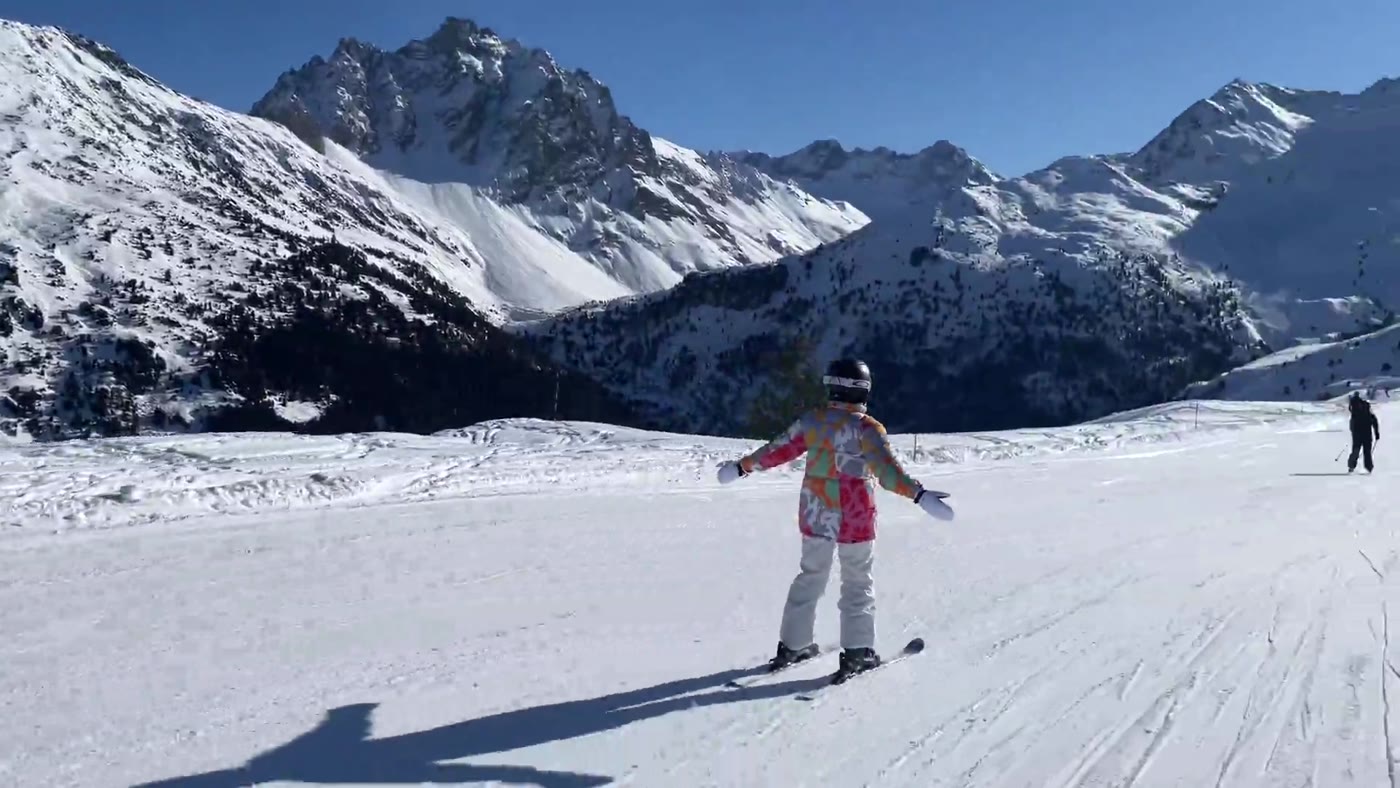
If your child thrives in a group, if budget decides whether the holiday happens at all, or if you are looking for a lesson tomorrow morning, this is the right model. We point families towards it every season.
The private school, and its reason to exist.
At the other end sit a handful of small independent structures, ours among them. We do not exist against the model above. We exist for the narrow band of guests it does not suit.
That band is thin, and its needs are specific. It wants to know which instructor, by name, before it books rather than on the morning of the first lesson — chosen from a team small enough to read about. It travels with three nationalities under one roof and expects the instructor's language to be matched deliberately, not endured. It expects the week to be arranged around the lesson — lift passes, equipment delivered to the chalet, a table held at midday — rather than fitted into a timetable.
All of that has a cost, and it is structural: an instructor devoted to one family for the day cannot have that day absorbed by several groups. The price does not buy a better diploma. It buys exclusivity and organisation.
Between the two sits a third model: mid-sized independent schools offering both group and private tuition with more flexibility than the village school. They are often an excellent compromise, and we have no reason to speak ill of them.
What actually drives the price.
Comparing hourly rates between schools teaches you almost nothing, because the hours do not contain the same thing. Four questions make a comparison useful — ask them of whoever you are considering, ourselves included.
- How many pupils will this instructor have alongside us? This is the first driver of price, by some distance.
- Will you know the instructor's name before you pay? Most schools will do their best to honour a request; fewer commit to a name at booking.
- What does the rate include beyond time on snow? Passes, equipment, scheduling, lunch reservations — billed separately or included, the apparent price gap sometimes reverses.
- What is the cancellation policy, and is the deposit recoverable? A tedious question until the morning a child wakes up ill.
Our own answers: never another family in the lesson, a named instructor confirmed in writing before the deposit, the surrounding organisation included, and a cancellation policy set out in our terms. Our rates start at €350 for a half day and €600 for a full day. We are not the cheapest option, and we will never pretend to be.
You will find no other school's prices here. They vary by village and by season, and an approximate comparison would serve nobody. Ask them directly — then compare what each price contains.
Does the village change things?
Somewhat, though not always as you would expect. The five villages of the 3 Valleys draw different guests, and the teaching on offer has shaped itself accordingly.
- Val Thorens — the highest resort in Europe, and therefore the most snow-sure from December to April. Vast beginner areas at altitude: a first ski holiday has its best chance here, whichever school you choose.
- Courchevel — private demand is densest at 1850, and consequently tightest over the festive weeks. Plan further ahead here than anywhere else.
- Méribel — central on the domain, ideal if you want to ski all three valleys in one week without spending the day on lifts.
- Les Menuires and Saint-Martin de Belleville — quieter, more affordable, with access to the same linked domain. The best value in the 3 Valleys, and our instructors travel there as readily as anywhere.
We work across all five, and we meet our guests at their chalet door — including a different village each morning, if the week calls for it.
Choosing, honestly.
There is no best school in the abstract. There is a model that fits your stay, and two that do not.
Go to a village school if:
- your children are beginners and enjoy learning in a group;
- budget is the deciding criterion;
- you are looking for a lesson at short notice, without having planned;
- a school open in the village tomorrow morning matters more to you than a name settled weeks ahead.
Go to a private school like ours if:
- you want the instructor named and confirmed before you commit;
- the instructor's language must be chosen, not left to chance;
- you would rather the week were arranged around you than the reverse;
- you plan ahead — our schedules are built weeks in advance, months over the festive periods.
If the first list sounds more like you, tell us anyway: we know the domain and will point you in the right direction, with nothing to sell. A poor commercial calculation in the short term, and the best one there is over a decade.